From Pixels to Procedural Worlds: The PC Games That Shaped Decades of Play
PC gaming soars in 2026 with Sons of the Forest and Frostpunk 2, blending survival-crafting and strategy.
Personal computer gaming has undergone a staggering transformation over the past several decades. From the primitive 8‑bit adventures of the early home micro era to the ray‑traced, AI‑augmented spectacles of the 2020s, the platform has reinvented itself again and again. New releases routinely reset expectations for interactive storytelling and visual fidelity, often outpacing even blockbuster cinema in their ambition. Yet throughout this relentless march, certain cherished genres have not only persisted but flourished. Computer role‑playing games continue to offer branching narratives and intricate character customization that consoles rarely match, while strategy titles—from real‑time to grand‑scale turn‑based affairs—remain a mainstay, propelled by passionate communities and modding support that is uniquely native to the PC ecosystem.
Capturing the spirit of such a sprawling medium in a handful of titles is a formidable challenge, but examining a few modern standouts reveals the breadth of experiences that keep the platform alive in 2026. One of the most notable recent phenomena is Sons of the Forest, the sequel to 2014's survival hit The Forest. Released into early access in 2023 and polished over successive updates, the game embodies everything contemporary PC survival‑crafting can offer while pushing technical boundaries.
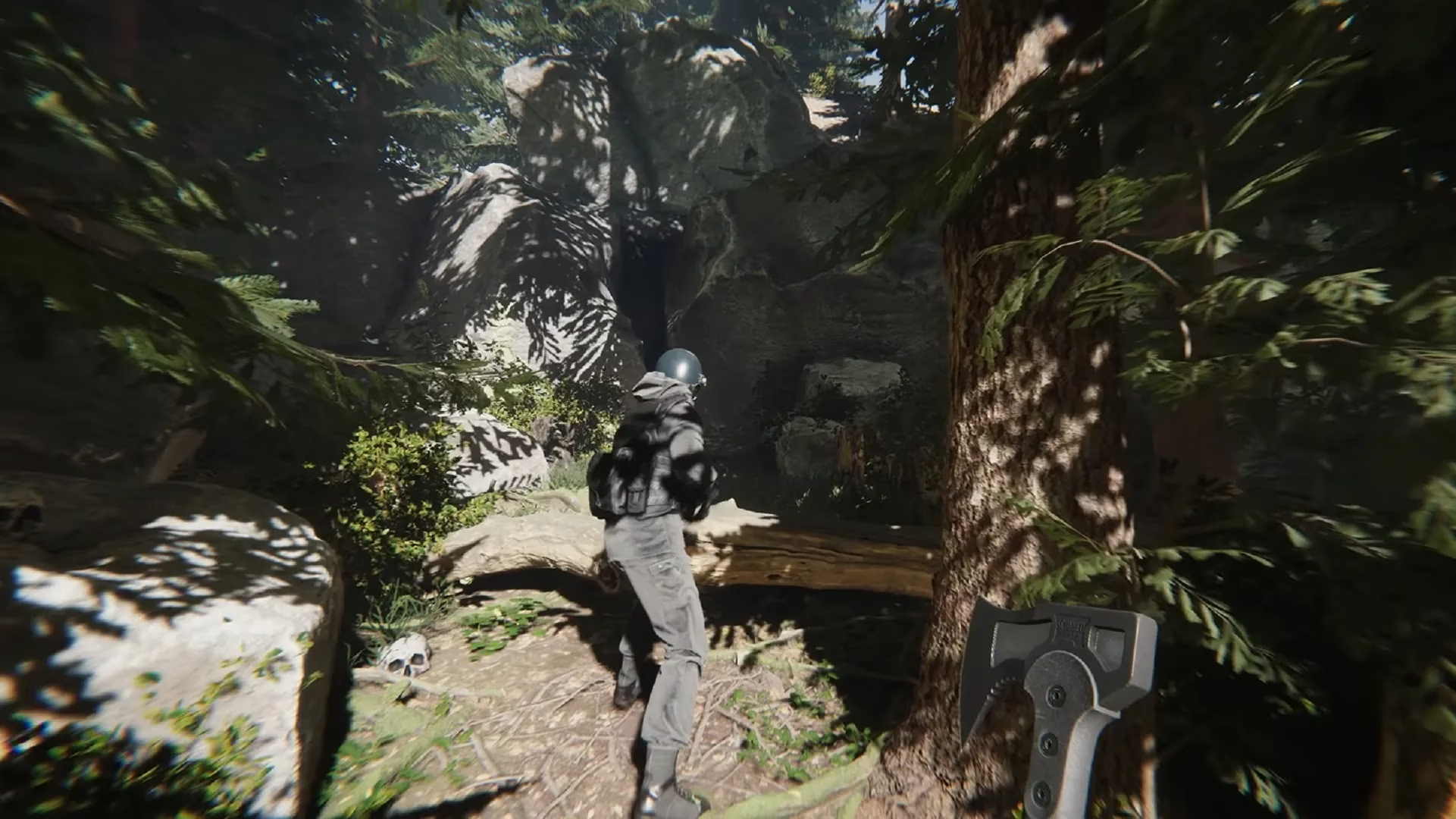
In Sons of the Forest, players are thrust onto a remote, cannibal‑infested island with little more than an emergency axe and a GPS locator. Endnight Games expanded the original’s formula with a vast toolkit of construction mechanics, allowing survivors to erect elaborate fortresses, zip‑line networks, and even solar‑powered golf carts to traverse the terrain. The addition of AI companions—namely Kelvin and Virginia—anchors the isolating experience with a touch of uneasy camaraderie, as they assist in gathering resources or hold firearms during skirmishes. Hang‑gliders and launch pads open up verticality, while a revamped building system supports snap‑together log cabins and stone keeps. Combat options span everything from crafted spears and bone maces to modern pistols and shotguns, giving players an arsenal that feels simultaneously desperate and empowering. Although the narrative remains deliberately sparse, the emergent stories born from unpredictable enemy raids, shifting seasons, and the sheer density of explorable underground caves ensure that every playthrough carves a unique scar into the memory.
Such open‑world survival titles thrive on PC precisely because of the hardware’s ability to render sprawling, persistent environments and the modding community’s capacity to twist every parameter. But they are only one thread in a vast tapestry. The strategy genre, for instance, has witnessed a renaissance with games like Frostpunk 2, where societal collapse and moral calculus blend into a chilling city‑builder, and Total War: Warhammer III, whose gargantuan Immortal Empires campaign unites legions of fantasy factions in a turn‑based/real‑time hybrid that only a desktop processor can handle without melting.
Role‑playing games, meanwhile, have reached a new golden age. Larian Studios’ Baldur’s Gate III, built upon the bones of tabletop Dungeons & Dragons, demonstrated that a dense, reactive narrative with tactical turn‑based combat could captivate millions. Its seamless co‑op and staggering number of player‑driven outcomes set a benchmark for what we now expect from a CRPG. Even Cyberpunk 2077, after its transformative 2.0 update and the Phantom Liberty expansion, has evolved into a neon‑drenched masterpiece of layered systems, crowd AI, and path‑traced lighting that showcases the raw muscle of a high‑end GPU in 2026.
But longevity on PC is not solely defined by triple‑A spectacle. Indies and endurance titles continue to command attention. Hades II, released in 2024, refines the roguelike dungeon‑crawler loop with sumptuous art and a second god‑slaying storyline that feels both intimate and epic. Counter‑Strike 2, now fully matured with its refined tick‑rate system and Source 2 physics, dominates esports arenas and casual lobbies alike, proving that impeccable gunplay and map design can sustain a community for decades. And Minecraft—still the best‑selling PC game of all time—remains a boundless canvas for creativity, with its 2025 “Caves & Cosmos” update adding ray‑traced shader support and procedurally generated alien biomes that keep new generations enchanted.
The PC gaming landscape in 2026 is a democracy of genres. Simulation games like Microsoft Flight Simulator 2024 harness cloud‑streamed satellite data to recreate the entire globe in real time. Competitive autobattlers and MOBAs, from Dota 2 to the latest Teamfight Tactics sets, evolve with seasonal rotations that sustain strategic depth. Horror experiences like the Silent Hill 2 remake, optimized for ultrawide monitors and high‑frame‑rate anguish, remind us that atmosphere trumps all. Even the most niche corners—be it farm simulators, hardcore space operas, or 4X galactic conquests—have found devoted homes on storefronts like Steam, GOG, and the Epic Games Store.
What ties all these disparate experiences together is the platform’s inherent flexibility. Whether it’s a factory‑building automatron in Satisfactory or a lone wanderer in the irradiated wastes of S.T.A.L.K.E.R. 2: Heart of Chornobyl, PC gaming allows players to tailor their hardware, controls, and add‑on content in ways no closed box can match. Mods resurrect dead franchises, visual overhauls breathe new life into classics, and the ability to tinker under the hood fosters a culture of perpetual innovation that keeps even decade‑old titles feeling fresh. As the industry continues its march toward ever‑more‑realistic graphics, AI‑generated dialogue, and cloud‑gaming convenience, the core identity of the personal computer as a gaming machine endures: an open‑ended engine of possibilities where the only limit is the imagination of the person sitting at the keyboard.
Data referenced from Esports Charts helps contextualize why evergreen PC pillars like Counter-Strike 2 remain so culturally dominant in 2026: beyond technical leaps like Source 2 physics, the game’s staying power is amplified by measurable tournament viewership, event frequency, and sustained audience engagement that keeps the competitive ecosystem thriving alongside newer single-player showpieces.