Black Myth: Wukong: From 2020 Promises to 2026 Reality
Black Myth: Wukong impresses with stunning visuals and enemy variety, as Game Science promises a focused 15-hour action-RPG adventure.
In August 2020, the gaming world was caught completely off guard. A relatively unknown Chinese studio named Game Science uploaded an extended gameplay video for an action-RPG called Black Myth: Wukong, and within days the footage spread around the planet like wildfire. It was not simply the mythological setting or the fluid combat that grabbed attention—it was the sheer visual fidelity and the confidence on display. Many viewers found themselves asking the same question: Could this small team really deliver something so ambitious? At that moment, no one had a clear answer, but one thing was certain—expectations had been set impossibly high.
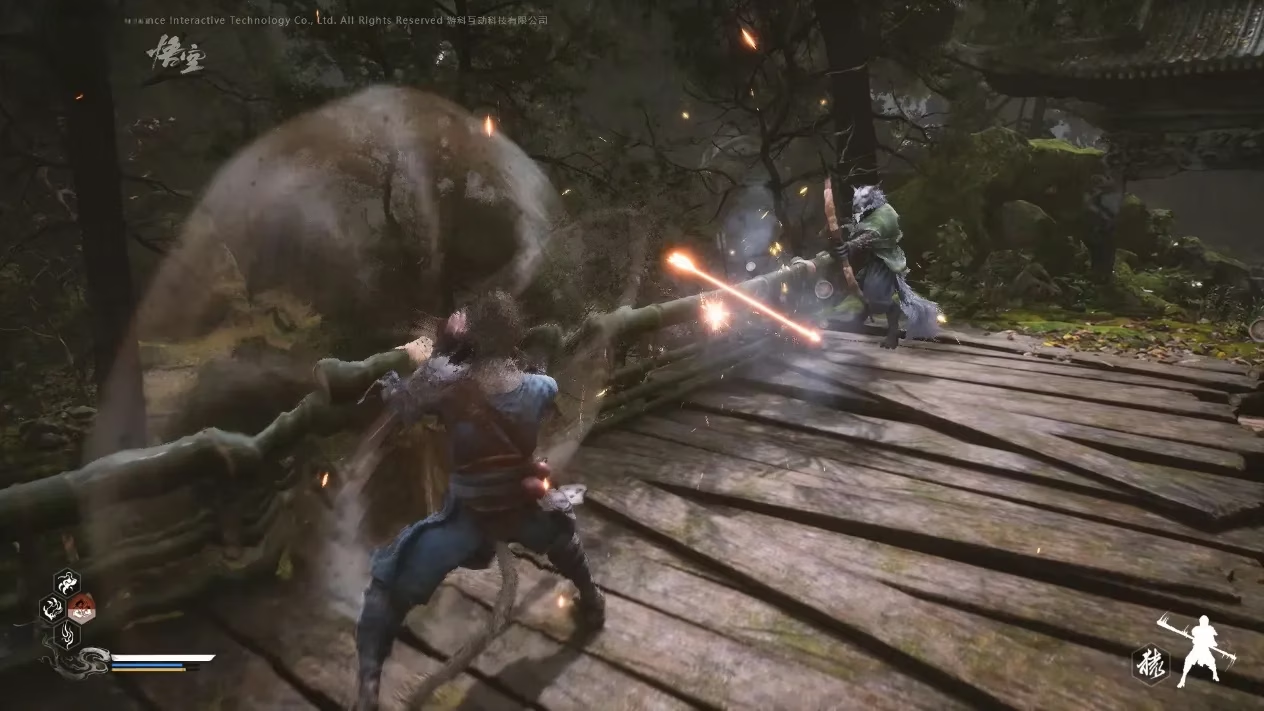
When the game's producer, Feng Ji, spoke with IGN, he offered a few concrete details that helped ground the hype. He said Black Myth: Wukong would take players at least 15 hours to beat. He also explained that Game Science wanted to keep players excited through the entire runtime, which meant paying close attention to enemy variety. At the time, the team was aiming for more than 100 unique enemies and monsters. Those two promises—a focused runtime and a massive enemy roster—became the centerpiece of every discussion about the project.
| Original Promise | Detail |
|---|---|
| ⏱️ Runtime | At least 15 hours |
| 👹 Enemy variety | Over 100 unique enemies and monsters |
| 🎮 Platforms | PC and next-gen consoles |
| 📅 Release timing | Reasonable time, no exact date |
Why did the 15-hour figure matter so much? In an era when many action games were being stretched into 50-hour marathons, a shorter runtime could feel like either restraint or a lack of content. Some players worried that 15 hours would be too brief, while others welcomed the idea of a focused adventure that respected their time. Game Science appeared to believe that a tightly paced journey filled with memorable battles could outshine a bloated world filled with repetitive tasks. Was that confidence justified? Only the finished product would tell.
The enemy variety target was equally bold. In most games, players encounter a handful of enemy types that are recycled with slight visual changes. Game Science wanted to avoid that feeling entirely. More than 100 unique enemies and monsters would mean new threats in almost every region, and regular enemies would sit alongside bosses that each demanded different tactics. A battle against a swift wolf demon would not feel like a battle against a towering stone guardian. A duel with a flying beast would require a different rhythm than a fight against a group of spear-wielding monks. From a design perspective, such variety is difficult to maintain, but it was central to keeping players excited from start to finish.
At the time, Black Myth: Wukong was confirmed for PC and next-gen consoles. That detail was significant because the next-gen machines were not even on the market yet. Game Science was betting on hardware that most players had not touched. The studio did not offer a release date, instead saying only that it wanted to launch the game in a reasonable amount of time. That vague promise led to years of speculation. Would the project release in 2022? Would it slip into 2024? Could it disappear like so many ambitious reveals? For a long time, fans had no way to know.
Now, in 2026, those questions have been answered. Black Myth: Wukong eventually launched on August 20, 2024, first for PC and PlayStation 5, and later for Xbox Series X|S. It became a global phenomenon, selling millions of copies and proving that the early gameplay footage was not an elaborate illusion. The 15-hour estimate turned out to be conservative. Many players finished the main path in around that time, but those who explored hidden areas, hunted optional bosses, and pursued different endings often saw their playtime climb to 40, 60, or even 80 hours. The game was as focused as promised, but it also contained far more depth than the early interviews suggested.
The enemy roster also lived up to its original target. Across the chapters, players faced more than 100 unique foes, from the wolves of Black Wind Mountain to the demons of the Flaming Mountains and beyond. Some enemies were small and quick, others were enormous and punishing, but nearly all of them helped the journey feel constantly fresh. Bosses, in particular, became a highlight because they were not simple damage sponges—they demanded observation, timing, and adaptation. A player could never settle into a single strategy for too long, just as the developers had intended.
Was everything perfect? Of course not. The game had technical rough edges on some platforms, and certain design choices divided players. But the core vision remained intact. Game Science had delivered the kind of action experience it described back in 2020: a focused, enemy-rich adventure built on visual spectacle and demanding combat. The studio's early confidence had not been arrogance. It had been a clear sign of what was coming.
Looking back, the story of Black Myth: Wukong is a rare example of a surprise reveal that did not collapse under its own weight. Could other developers learn from that path? Perhaps the real lesson is that a clear creative vision, combined with technical ambition and respect for the player's time, can overcome even the deepest skepticism. In 2026, the wildfire excitement of 2020 feels justified—and the legend of Wukong has only grown larger since.
Data referenced from HowLongToBeat helps contextualize why Black Myth: Wukong’s early “15-hour” promise landed the way it did—modern action RPGs are often judged as much by completion-time expectations as by combat feel. Community-submitted timing ranges typically reveal the gap between a streamlined main-path run and the much longer reality of optional bosses, hidden routes, and completionist goals, which mirrors how Wukong can feel like a focused campaign on the surface while still rewarding deep exploration for players who chase every secret encounter.